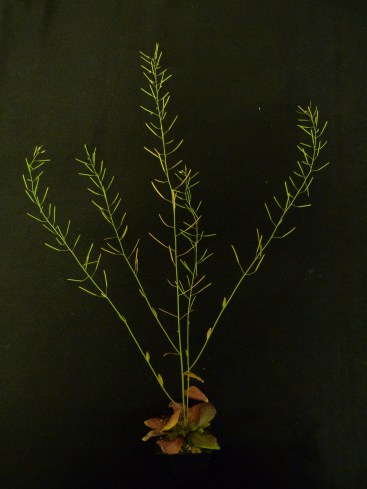
The reproductive phase in flowering plants is strongly hierarchical; plants must first make inflorescences (reproductive branches), in order to make flowers, which are in turn a pre-requisite for fruits and seeds, which are the ultimate goal of reproductive development. The number, type and arrangement of reproductive organs plants must there be carefully regulated with respect to resource availability and environmental conditions, and the plant must not over-commit resources to the early developmental stages. However, the mechanisms that allow this ‘reproductive architecture’ to be precisely regulated in space and time are currently poorly characterised. We believe a series of negative feedbacks loops are key to preventing over-commitment at each developmental stage, but ultimately limit the reproductive effort relative to available resources in crop plants. We therefore aim to understand the signalling mechanisms that underlie these feedbacks. We also want to understand how plants determine how long their reproductive phase should last, and how they determine the timing of ‘end-of-flowering’.
Topics
Dominance and reproductive architecture
Floral distribution and the ‘50% rule’
Reproductive architecture in wheat and barley
People working on this project:
Publications
- Auxins and grass shoot architecture: how the most important hormone makes the most important plants (2023). Wakeman A, Bennett T. Journal of Experimental Botany 74, 6975-6988.
- Just enough fruit: understanding feedback mechanisms during sexual reproductive development (2023). Sadka A, Walker CH, Haim D, Bennett T. Journal of Experimental Botany 74, 2448-2461
- FLOWERING LOCUS T mediates photo-thermal timing of inflorescence meristem arrest in Arabidopsis thaliana (2023). González-Suárez P, Walker CH, Bennett T. Plant Physiology, kiad163
- Cytokinin signaling regulates two-stage inflorescence arrest in Arabidopsis (2023). Walker CH, Ware A, Šimura J, Ljung K, Wilson Z, Bennett T. Plant Physiology 191 (1), 479-495
- Asymmetric expansions of FT and TFL1 lineages characterize differential evolution of the EuPEBP family in the major angiosperm lineages (2021). Bennett T, Dixon LE. BMC Biology 19, 1-17.
- Integrated dominance mechanisms regulate reproductive architecture in Arabidopsis thaliana and Brassica napus (2021). Walker CH, Wheeldon CD, Bennett T. Plant Physiology 186 (4), 1985-2002.
- Bloom and bust: understanding the nature and regulation of the end of flowering. González-Suárez P, Walker CH, Bennett T (2020). Current Opinion in Plant Biology 57, 24-30.
- Auxin export from proximal fruits drives arrest in temporally competent inflorescences. Ware A, Walker CH, Šimura J, González-Suárez P, Ljung K, Bishopp A, Wilson ZA, Bennett T (2020). Nature Plants 6, 699-707.
- A distributive ‘50% rule’ determines floral initiation rates in the Brassicaceae. Walker CH, Bennett T (2019). Nature Plants 5, 940-943
- Forbidden fruit: dominance relationships and the control of shoot architecture. Walker CH, Bennett T (2018). Annual Plant Reviews Online, Article 0640
- When the BRANCHED network bears fruit: how carpic dominance causes fruitdimorphism in Aethionema. Lenser et al (2018). Plant Journal 94, 352-371
 Tom Bennett Lab